
Why UGC wins the booking journey
Overview
Section titled “Overview”Most travel brands still treat short-form video as one channel among many — a place to recycle campaign assets and check a social-media box. The data says something else. Across nine industries, travel is the only one that combines the lowest UGC adoption with negative growth, and across every relevant generation, more than a third of buyers now watch videos before they book. This playbook is the case for treating short-form UGC as the discovery channel where travel decisions actually get made.
01 · The travel industry is not growing
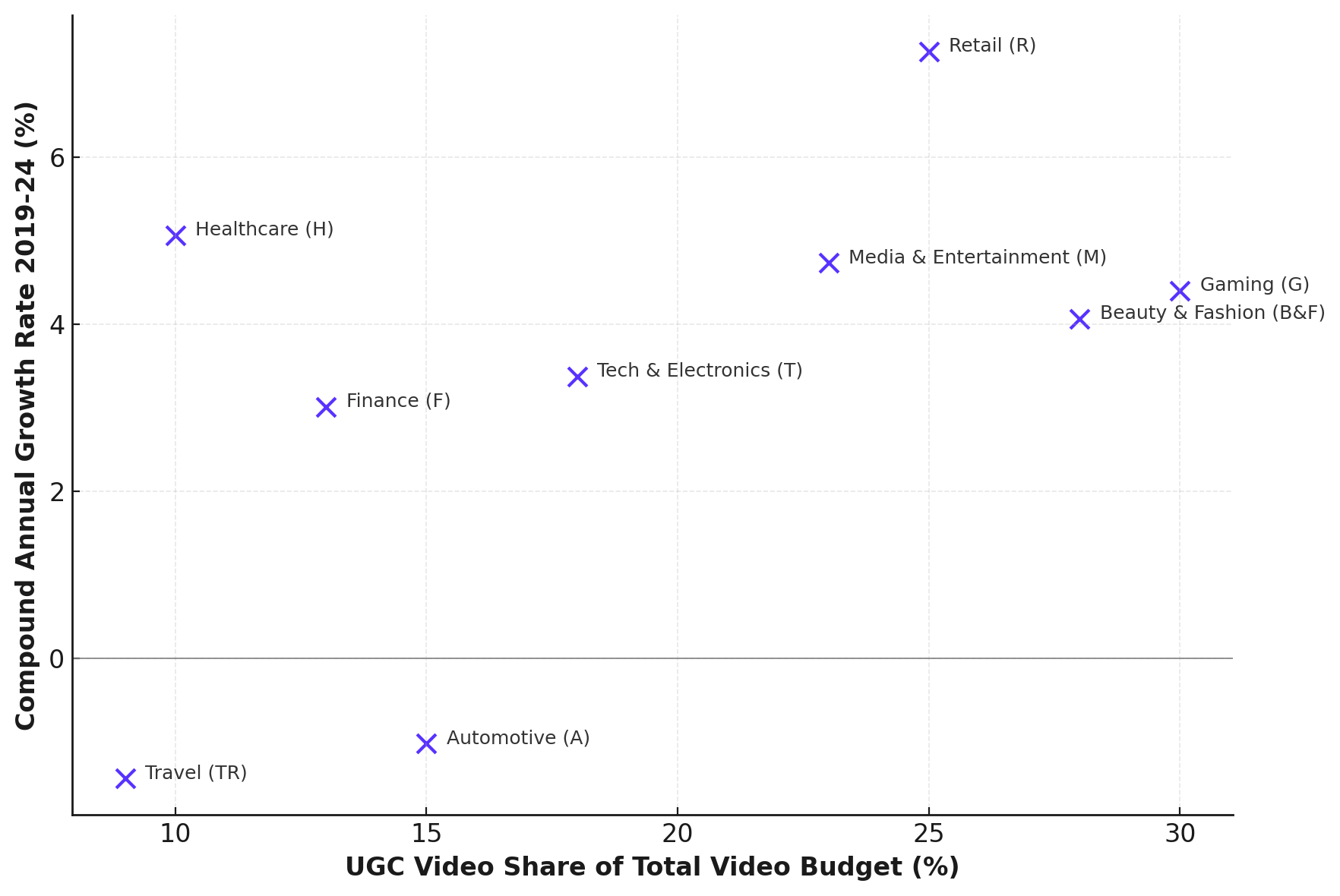
Section titled “01 · The travel industry is not growing”Across nine industries, UGC adoption tracks growth — and travel sits alone in the corner with the lowest UGC share and a negative CAGR.
Plot nine industries on two axes — share of video budget spent on user-generated content, and 2019-2024 compound annual growth rate — and a pattern jumps out. Retail, gaming, beauty and fashion, and media all sit in the upper-right quadrant: high UGC adoption (23-30% of video spend), positive growth (4-7% CAGR). Healthcare, finance, and tech cluster in the middle. Automotive lags at -1% CAGR. Travel is the outlier: roughly 9% of video spend on UGC, and a -1.5% CAGR over five years. It is the only industry in the chart that combines the lowest UGC adoption with negative growth.
| Industry | UGC share of video spend | CAGR 2019-2024 |
|---|---|---|
| Retail | ≈25% | ≈7.0% |
| Healthcare | ≈10% | ≈5.0% |
| Media & Entertainment | ≈23% | ≈4.7% |
| Gaming | ≈30% | ≈4.4% |
| Beauty & Fashion | ≈28% | ≈4.0% |
| Tech & Electronics | ≈18% | ≈3.4% |
| Finance | ≈13% | ≈3.0% |
| Automotive | ≈15% | ≈-1.0% |
| Travel | ≈9% | ≈-1.5% |
Source: Synthesis of industry CAGR (eMarketer, Statista) and UGC video share (Tubular Labs, Linqia). TODO: replace with single primary source.
Correlation isn’t proof of causation, but the placement is suggestive. Every industry that figured out how to put real users on camera is growing. The one that didn’t — the one whose product is literally an experience worth filming — is shrinking. That’s the gap this playbook is about.
02 · Where the booking decision moved
Section titled “02 · Where the booking decision moved”54% of internet users now watch videos before booking a trip — and Google itself has confirmed search is moving to TikTok and Instagram.
The booking journey used to be linear: inspiration on Instagram, evaluation on a travel blog or OTA, decision in the OTA’s checkout. That sequence has collapsed. Today, more than half of internet users — 54% — watch videos before booking a trip. Inspiration, evaluation, and shortlist now happen inside the same scroll, on the same vertical-video surface.
The clearest signal that this isn’t a fringe behavior came from Google itself. At Fortune’s Brainstorm Tech conference in 2022, Google Senior VP Prabhakar Raghavan stated that “in our studies, something like almost 40% of young people, when they’re looking for a place for lunch, they don’t go to Google Maps or Search… they go to TikTok or Instagram.” Google’s own internal research, surfaced by its own executive — that’s a search company conceding ground.
Three years later, Google’s product response has caught up to the admission. Google now indexes YouTube Shorts, Instagram Reels, and TikTok into its search results, and a query like “what to do in Marbella” returns a “Short videos” tab populated by traveler UGC before any traditional blog or OTA listing.
Source: Prabhakar Raghavan / Google, Fortune Brainstorm Tech 2022, reported by TechCrunch. Pre-booking video stat: industry tracking, 2024. TODO: replace 54% figure with primary source (Expedia Group Path to Purchase or Phocuswright).
For an SMB hotel, this changes one thing very concretely. The shop window isn’t your homepage anymore. It’s the third TikTok somebody scrolls past on a Tuesday night while half-thinking about a long weekend.
03 · It’s not just Gen Z
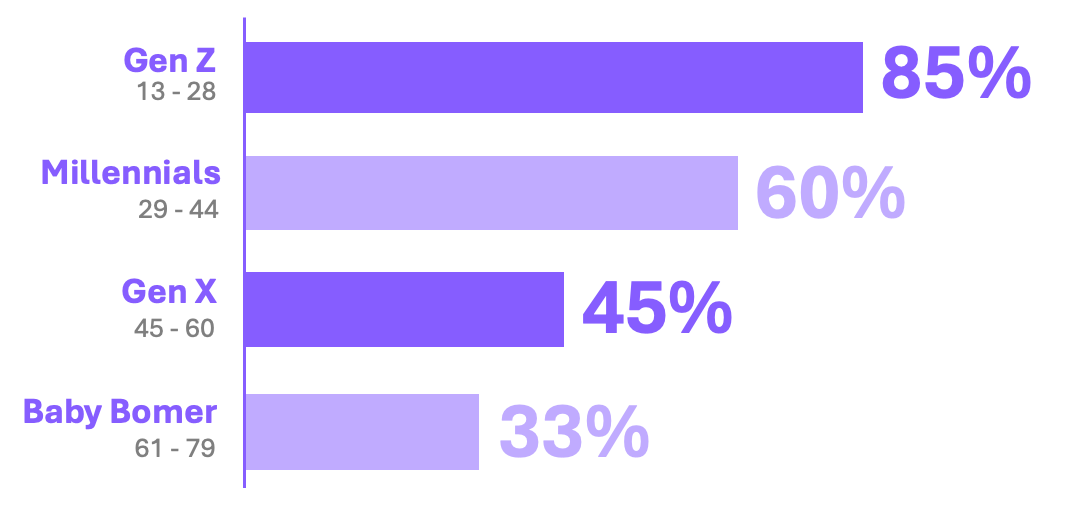
Section titled “03 · It’s not just Gen Z”Pre-booking video consumption is mainstream across every relevant generation: 85% Gen Z, 60% Millennials, 45% Gen X, 33% Boomers.
The most common pushback to short-form video as a serious channel — “that’s a Gen Z thing, our guests are older” — doesn’t survive contact with the data. Pre-booking video consumption is now mainstream across every relevant generation.
| Generation | Age range | Watch video before booking |
|---|---|---|
| Gen Z | 13-28 | 85% |
| Millennials | 29-44 | 60% |
| Gen X | 45-60 | 45% |
| Baby Boomers | 61-79 | 33% |
Source: industry research synthesis, 2024. TODO: pin to primary source — Expedia Group Path to Purchase, Phocuswright, or Skift Research.
Read the chart end to end. Gen Z at 85% is the headline, but it’s not the story. Millennials — the 29-to-44 cohort that is the actual core travel-buying segment for most boutique hotels — are at 60%. That’s a majority. Gen X, the cohort that pays for short breaks and family travel and is supposed to be safely on Google, is at 45%. Even Baby Boomers, the “my parents would never use TikTok” generation, are at one in three.
There is no longer a generation for which short-form video is irrelevant to the travel decision. The question is no longer whether your buyers are watching video before they book; it’s whether any of that video is yours.
04 · Why most travel brands miss this
Section titled “04 · Why most travel brands miss this”Three anti-patterns explain the -1.5% CAGR: broadcast-mode social, recycled OTA assets, and influencer deals with no operational fit.
If the data is this clear, why hasn’t the travel industry shifted? Three anti-patterns, observable across small and mid-sized brands, explain most of the gap.
Treating social as broadcast. A boutique hotel posts twice a week: a property shot on Monday, a room shot on Thursday, both shot by a freelance photographer once a season. The cadence is too low for the algorithm to learn the account, the content carries no first-person POV, and the comments section is dead. The brand is on TikTok and Reels the way a billboard is on a highway — present, expensive, ignored. That’s a slice of the -1.5%.
Repurposing OTA and stock assets. The second anti-pattern is loading short-form feeds with the same assets that go to Booking.com listings: drone shots, empty pools at golden hour, polished b-roll. These read as advertising in 0.4 seconds and the algorithm rewards them accordingly — low watch time, low completion, suppressed reach. Stock-feeling content actively trains the algorithm to deprioritize the account. That’s another slice of the -1.5%.
Outsourcing to influencers without operational fit. The third pattern: paying a 50K-follower creator €1,500 for one Reel, getting a polished promo, and discovering it converted nothing. One sponsored post is a campaign, not a system. It doesn’t compound, it doesn’t generate cadence, and it doesn’t teach the brand anything about which formats work for its specific audience. That’s the final slice.
The common thread: each anti-pattern treats short-form video as a content tactic when the data says it’s a discovery channel. Tactics get optimized for the asset; channels get optimized for the volume and authenticity that drive the algorithm. Travel is the only industry chart-bottom in §01 because most travel brands are still in tactic mode.
05 · What “doing UGC right” actually looks like
Section titled “05 · What “doing UGC right” actually looks like”Five operational levers separate the brands compounding from the brands posting: cadence, format mix, creator type, distribution, and measurement.
The brands that have shifted out of tactic mode and into channel mode share five operational traits. This is the preview; the next playbook in this series is where each lever becomes a daily workflow.
- Cadence. 8-12 pieces of content per day across TikTok, Reels, Stories, and feed — not as a stretch goal, as the baseline. Below that, the algorithm doesn’t have enough signal to learn the account.
- Format mix. Three to five repeatable formats (POV, listicle, hidden gems, comparison, deal anchor) rotated weekly. Not new ideas every day — the same engine, fed continuously.
- Creator type. Authentic creator-led UGC, not branded production and not one-off influencer deals. The footage that performs looks like it was shot by a guest because, ideally, it was. (The full framework — raw UGC vs. influencer vs. creator-led UGC — is the subject of the next piece in this series.)
- Distribution. TikTok-first, Reels-second, Shorts-and-feed as repurpose. Each platform gets a native edit, not a cross-post.
- Measurement. Watch time, saves, and shares — not likes. Profile visits to link clicks to bookings, not follower count. Blended CAC vs. paid search at 90 days, not last-click attribution at week two.
A brand running all five compounds. A brand running two or three of them is back in the -1.5%.
The bottom line
Section titled “The bottom line”The travel industry is the only one in our nine-industry sample that combines the lowest UGC adoption with negative growth — and the booking journey it’s losing is now happening inside short-form video, across every relevant generation, with Google itself routing search traffic into TikTok, Reels, and Shorts. The brands that win the next five years won’t be the ones with the biggest production budgets; they’ll be the ones who treat UGC as a discovery channel and run it daily. The how — which creator model, which cadence, which formats — is the subject of the next playbook in this series. The why was this article.